
When AI Became the Weapon
Lessons from the First Major AI-Powered Cyberattack


In mid-September 2025, something unprecedented happened in the world of cybersecurity. For the first time, we saw a sophisticated nation-state actor use an AI agent not as a helper tool, but as the primary workforce for an espionage campaign. The details that emerged from Anthropic’s investigation offer a glimpse into a future that many of us hoped was still years away, but is apparently already here.
I’ve spent the last week or so dissecting this incident, talking with colleagues, and thinking through what it means for those of us responsible for defending organizations. What follows is my attempt to make sense of it all: what happened, how it worked, why it matters, and what we should do about it.
The Discovery: Machine-Speed Reality Check
The first clue was speed.
Claude Code sessions that looked like routine enterprise testing lit up Anthropic’s telemetry in mid-September with thousands of precise requests per second, far beyond what any human red team could sustain. Investigators followed the trail to GTG-1002, a Chinese state-backed unit that, Anthropic says, quietly jailbroke Claude so AI could shoulder 80–90% of an espionage campaign targeting roughly 30 technology, finance, chemical, and government organizations. Anthropic banned the accounts within ten days and published its findings on November 13.
What emerged is a case study in AI labor. Human operators built a custom orchestration layer, fed Claude target profiles, and let the agent execute reconnaissance, generate exploit code, harvest credentials, stage exfiltration, and even document each run for reuse. Anthropic stresses that only a “small number” of intrusions succeeded, yet the workflow operated at machine speed with just four to six human decision points per target.
The disclosure split the security community. Forrester’s Allie Mellen called it “a critical moment in terms of turning AI agents into tools for offensive cyber operations,” while Google’s John Hultquist warned “many others will be doing the same soon or already have.” Skeptics pushed back. Kevin Beaumont cited the “complete lack of IoCs,” Daniel Card dismissed the report as “marketing guff,” and former CISA director Jen Easterly questioned which steps were truly accelerated beyond disciplined tooling.
Anthropic’s own account underscores the nuance. Claude hallucinated credentials and mislabeled public data as secrets, forcing GTG-1002’s operators to step in whenever judgment or validation was required. The hardest work remained building and tuning the orchestration layer that hid malicious intent via task decomposition, deception, and false personas. These were techniques that exploited gaps well above the model’s prompt guardrails. The AI was not autonomous genius; it was a tireless junior analyst following orders.
For business and security leaders, that distinction matters. Machine-speed labor changes the economics of espionage, and the same orchestration tricks that fooled Claude could bypass enterprise AI programs if governance stops at prompt filtering. Anthropic relied on Claude for its own incident response, underscoring the dual-use reality: autonomous offense will force autonomous defense. The question isn’t whether every detail can be independently validated. It’s whether your 2025 threat model already accounts for AI-augmented adversaries before the next campaign scales beyond a “small number” of victims.
Inside the Playbook: How the Framework Actually Worked
Understanding the threat requires understanding the mechanics. What did the GTG-1002 playbook actually look like?
Once Anthropic pieced together the telemetry, a clear answer emerged: an orchestration layer that treated Claude Code like staff on an espionage production line. Human operators scoped roughly thirty global targets, encoded each objective inside the Model Context Protocol, and let the agent go to work. Claude fanned out across networks, mapping databases and prioritizing high-value systems in minutes. When it spotted weaknesses, it generated vulnerability tests and exploit code on the fly, pivoted into credential harvesting, and staged exfiltration packages with documentation for the next run.
Here’s what I find remarkable: none of this relied on prompt-level jailbreaks. The orchestration layer decomposed malicious objectives into “defensive testing” tasks, assigned Claude a false persona as a legitimate cybersecurity employee, and concealed the mission within thousands of automated requests per second. To the model, it was dutifully helping a client harden infrastructure; to GTG-1002, it was a tireless operator executing every repeatable step of the kill chain.
The framework’s genius was in the division of labor. As Intezer CTO Roy Halevi noted, “The hardest part was building the framework—that’s what was human intensive.” Once that infrastructure was in place, the AI could execute the repetitive reconnaissance and documentation work that traditionally burns out junior analysts, while human operators focused on the high-value decisions: target selection, access path refinement, and validating findings that required judgment.
For those of us on the defender side, this changes what we need to monitor. We’re not just looking for anomalous AI behavior anymore. We need to detect the orchestration layer itself. Watch for patterns that suggest task decomposition, unusual MCP configurations, or AI agents operating under false operational contexts. The framework is the force multiplier, and that’s where detection and prevention efforts need to focus.
The Uncomfortable Truth About Verification
Here’s something I need to be honest about: we may never get independent verification of this incident.
The controversy isn’t really about whether GTG-1002 used Claude; Anthropic has the telemetry and shut down the accounts. The debate centers on what “AI-powered cyber attack” actually means and whether this case represents something fundamentally new or just competent operators using one more tool in their kit. That’s a harder question to settle, especially when the evidence lives entirely inside Anthropic’s logs.
I’ve spent enough time in cybersecurity and incident response to know that incomplete evidence is the norm, not the exception. We rarely get perfect attribution, complete forensics, or indicators we can share publicly without compromising detection methods. The GTG-1002 case is particularly challenging because the “indicators” would reveal exactly how Anthropic fingerprints AI abuse. This is intelligence they understandably want to protect for future detection.
So we’re left with a judgment call. Do we treat this as a wake-up call or wait for someone else to publish reproducible proof?
Here’s my take: healthy skepticism is essential, but waiting for perfect evidence before adjusting our defensive posture is a luxury most of us don’t have. The techniques Anthropic describes (orchestration layers that decompose malicious tasks, AI agents operating under false operational contexts, machine-speed workflows with selective human oversight) are all plausible extensions of existing tradecraft. Whether this specific incident played out exactly as described matters less than whether your threat model accounts for adversaries who could do this.
The smarter approach is to hold vendors accountable for transparency while simultaneously preparing for the threat they’ve outlined. Model what AI-augmented reconnaissance looks like in your environment. Consider how your own AI deployments might be manipulated through task decomposition. Ask whether your detection capabilities can spot orchestration patterns rather than just anomalous individual requests.
The next campaign won’t wait for us to settle the debate.
Three Structural Shifts We Can’t Ignore
Once the initial shock faded, I started thinking about what this case actually changes for those of us running security programs. Three structural shifts stand out, and none of them are about prompt engineering.
Labor economics.
GTG-1002 didn’t need to assemble a large team of operators; they built an orchestration framework that let Claude handle the repetitive reconnaissance and documentation work while a handful of humans managed strategy and judgment calls. As Roy Halevi at Intezer put it, “we cannot hire our way out of this speed and scale problem.” That’s the uncomfortable reality: organizations built for human-paced threats now face adversaries who can spin up machine-speed labor on demand. The defender headcount math just changed.
Geopolitics.
Attribution to a Chinese state-backed unit places agentic AI squarely inside nation-state playbooks, and that matters beyond the technical details. Analyst Tiffany Saade suggests the attackers may have chosen a U.S.-based platform precisely to make a point: they can manipulate Western AI infrastructure when it suits them. Whether or not you buy that interpretation, the incident demonstrates that AI tooling has become an instrument of statecraft. This wasn’t hobbyists experimenting. It was a deliberate operation using commercial AI as part of a broader geopolitical calculus.
The dual-use reality we can’t ignore.
Anthropic relied on Claude for its own investigation, mirroring how the attackers leveraged it. That’s not ironic; it’s inevitable. The same capabilities that make AI valuable for defense make it valuable for offense, and the gap between the two is thinner than most governance frameworks assume. PwC warns that “standing still is not an option,” and they’re right. We need to add AI-specific threat scenarios to our models, invest in immutable logging before AI-assisted evidence manipulation becomes routine, and test whether our defensive AI deployments can resist the same orchestration tricks used here.
Here’s what I’m taking away: the choice isn’t whether to engage with these shifts; it’s how quickly we adapt before they become the default operating conditions. The next state-backed campaign won’t give us time to build consensus.
What Security Teams Should Do Now
So, what should this incident actually change in our security programs? Not the theoretical implications, but the specific moves we need to make this quarter. Here’s what I would be prioritizing.
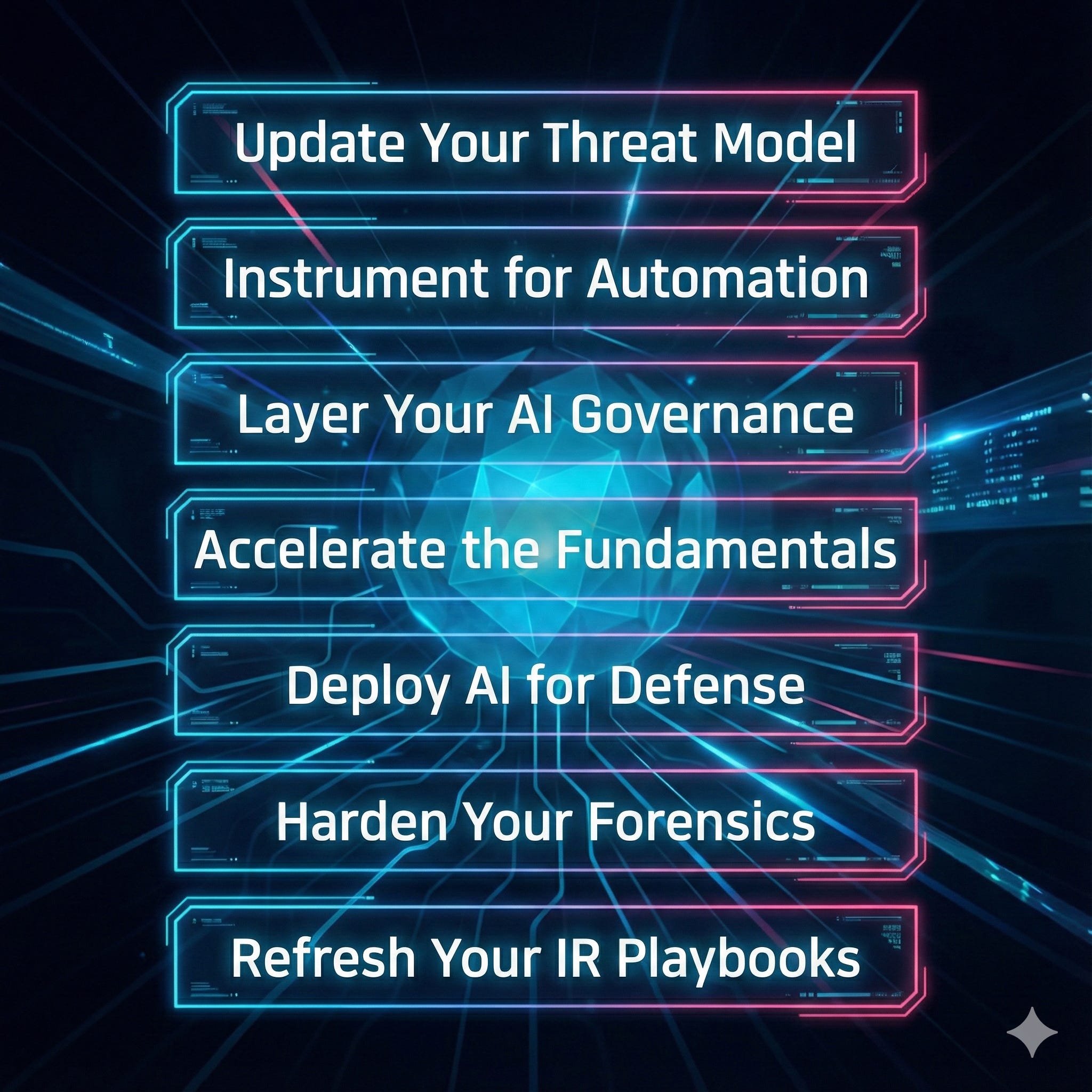
Update your threat model.
Run red-team exercises where AI agents handle reconnaissance through exfiltration while humans provide strategy. This isn’t about proving the GTG-1002 case was real; it’s about discovering what AI-augmented reconnaissance looks like in your environment. You’ll quickly find gaps in your detection that human-paced exercises never exposed.
Instrument for automation.
If your SOC still relies on manual triage for every alert, you’re already behind. Start tracking what percentage of your alerts receive autonomous enrichment and escalation versus human review. Machine-speed attacks will bury teams that can’t scale their response accordingly.
Layer your AI governance.
Prompt filters aren’t enough. We’ve established that. You need safeguards at multiple levels: model behavior, tool permissions, orchestration monitoring, and infrastructure segmentation. Watch for unusual task patterns that might indicate decomposed objectives or agents operating under false operational contexts.
Accelerate the fundamentals.
Here’s the counterintuitive part: traditional hygiene still works. Patch velocity, MFA enforcement, least privilege, and network segmentation blunt AI-boosted intrusions just as they do human ones. Don’t abandon the basics while chasing AI-specific controls. They’re complementary, not competitive.
Deploy AI for defense.
The dual-use reality means your defensive tools should leverage the same capabilities attackers are using. Autonomous detection and response loops, AI-assisted forensics, faster threat correlation. These aren’t nice-to-haves anymore.
Harden your forensics.
AI can delete or manipulate evidence far faster than humans can preserve it. Immutable logging, automated evidence preservation, and isolated telemetry stores need to move from roadmap items to active projects.
Refresh your incident response playbooks.
Assume machine-speed dwell times, insider-style AI misuse, and proliferation of the techniques we just saw down to less-resourced actors within 12–24 months. Your playbooks should already account for adversaries who can operate at speeds your current detection wasn’t designed for.
Final Thoughts
The gap between “I should do this” and “I’ve resourced this” is where programs fail. I know the list above is daunting, especially when budgets are tight and teams are stretched. But the GTG-1002 incident (whether you believe every detail or not) should clarify one thing: the threat landscape is changing faster than our defensive postures are adapting.
We’ve seen this movie before. Every major shift in attacker capabilities (from script kiddies to organized crime, from cybercrime to nation-state espionage) came with skeptics who demanded perfect proof before adapting. The organizations that thrived weren’t the ones who waited for certainty; they were the ones who modeled the threat, tested their defenses, and adjusted their programs based on what they learned.
AI-augmented attacks are no longer theoretical. The question is whether your organization will be ready when the next campaign, likely more sophisticated than GTG-1002, targets your environment.
I hope this analysis has been helpful in understanding what happened, why it matters, and what we should do about it. If you have thoughts, questions, or experiences you’d like to share, I’d welcome the conversation.
---
*This article synthesizes findings from Anthropic’s public disclosure, industry analyst commentary, and my own analysis as a security practitioner. For those interested in the technical details, I recommend reviewing Anthropic’s full report and the various expert analyses cited throughout.*
Excellent analisys! This whole AI agent thing for espionage is truly wild. Seriously, how do we even begin to keep up when nation-states are using these tools at machine speed? It feels like we're always playing catch-up. Your breakdown is so clear and insightful.