
The AI Paradox: Why Hyper-Efficiency Could Mean More Human Work
How a 19th-century economic theory can inform our thinking about AI and the future of work.

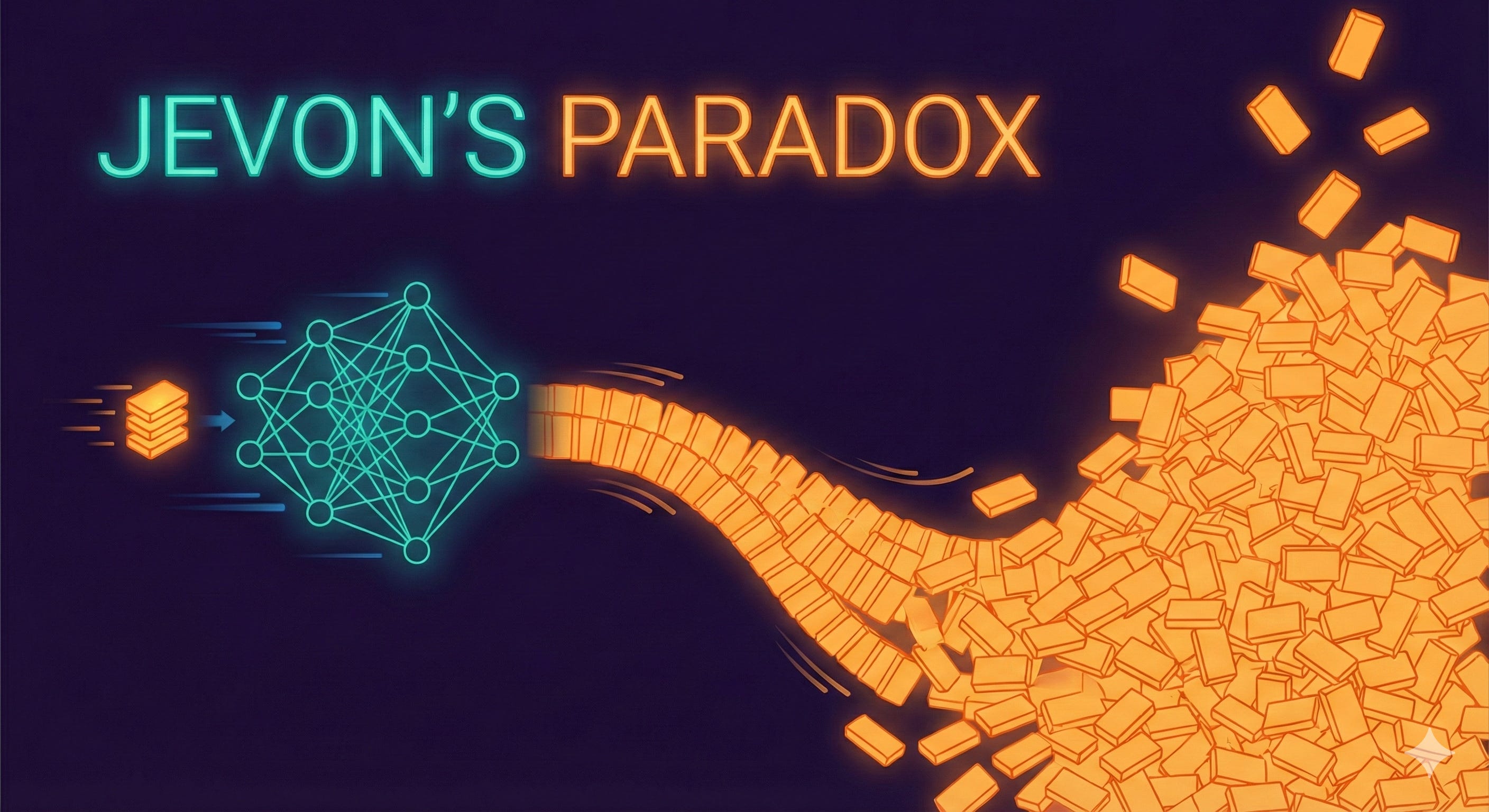
The conversation about AI is often dominated by a single, pervasive fear: that it will automate tasks, leading to widespread job displacement and a future with less work for humans. But what if this assumption is fundamentally flawed? What if history and economics point toward a completely opposite, and far more interesting, outcome?
I only recently learned about a 19th-century economic theory that clicked perfectly into place for me when reflecting on this challenge: Jevon’s Paradox. And I believe it’s one of the most critical concepts for understanding the real impact of AI on our work.
What is Jevon’s Paradox?
In the 1860s, the English economist William Stanley Jevons observed something that seemed to defy logic. Technological advancements had made steam engines incredibly efficient, requiring far less coal to produce the same amount of power. The logical assumption was that the nation’s total coal consumption would decrease.
Instead, the exact opposite happened. Coal consumption skyrocketed.
The reason was simple: making steam power more efficient made it cheaper. And because it was cheaper, it became practical for a whole new range of applications. People used it not just for existing tasks, but for entirely new industries, leading to a massive increase in the demand for coal.
This is Jevon’s Paradox: technological progress that increases the efficiency with which a resource is used tends to increase (rather than decrease) the rate of consumption of that resource.
We’ve Seen This Before: The Cloud Revolution
This isn’t merely a historical footnote. We have seen this exact dynamic play out in our own careers with the shift from on-premise data centers to cloud computing.
A decade or two ago, deploying a new server was a slow, capital-intensive process. It involved ordering hardware, racking it in a data center, and complex configuration. The process was a bottleneck.
The cloud made this resource—computing power—radically more efficient. With a few clicks, we could deploy a server in minutes for a fraction of the cost.
Did this efficiency lead to the elimination of infrastructure jobs? No. It sparked a Cambrian explosion of new software, services, and entire companies that would have been impossible before. The reduced cost and friction of innovation led to a massive increase in demand for infrastructure, creating a host of new, higher-value roles like DevOps Engineers, Site Reliability Engineers (SREs), and Cloud Architects to manage this sprawling and complex new ecosystem. The work didn’t disappear; it transformed.
AI is the New Steam Engine for Thought
And now, this same paradox is profoundly relevant to AI. Today, the “resource” being made more efficient isn’t coal or servers—it’s human cognition.
AI tools are making cognitive tasks like coding, data analysis, and content creation dramatically faster and cheaper. Following the logic of Jevon’s Paradox, the result won’t be a future with less work, but a surge in our collective ambition and an explosion of new products, services, and discoveries.
Consider these scenarios:
The Software Developer: An AI copilot allows a developer to write and test code twice as fast. The company doesn’t fire half its developers; it tackles a product roadmap three times as ambitious, creating more demand for senior engineers and architects to design and manage these complex new systems.
The Marketer: A generative AI can draft a dozen versions of ad copy in seconds. The marketing team isn’t made redundant; it’s now able to run hyper-personalized campaigns at a scale never before possible, creating a greater need for human strategists to analyze the results and creative directors to guide the brand’s voice.
The Future of Work is a Shift in Value
The true impact of AI won’t be in replacing humans, but in augmenting them. It will free us from the rote, repetitive aspects of our jobs and push us toward work that is uniquely human.
The value of our work will shift from execution to oversight. We’ll be focused on:
Strategic thinking and creative problem formulation
Quality control and expert refinement
Judgment, leadership, and empathy
The critical question for our careers is no longer “Will AI take my job?” but “How can I leverage AI to solve bigger, more interesting problems?”
This is a fundamental change in the nature of work, and it’s one we should be actively embracing. The conversation we should be having is not about how to stop AI, but about how to adapt our skills and organizations to ride this wave of unprecedented efficiency.
How are you seeing this play out in your industry? Are you using AI to simply replace tasks, or to augment your team’s capabilities and pursue bigger goals?